Billionaire Tech Peter Thiel Holds Closed-Door Lectures on the Rise of a One-World Antichrist Government

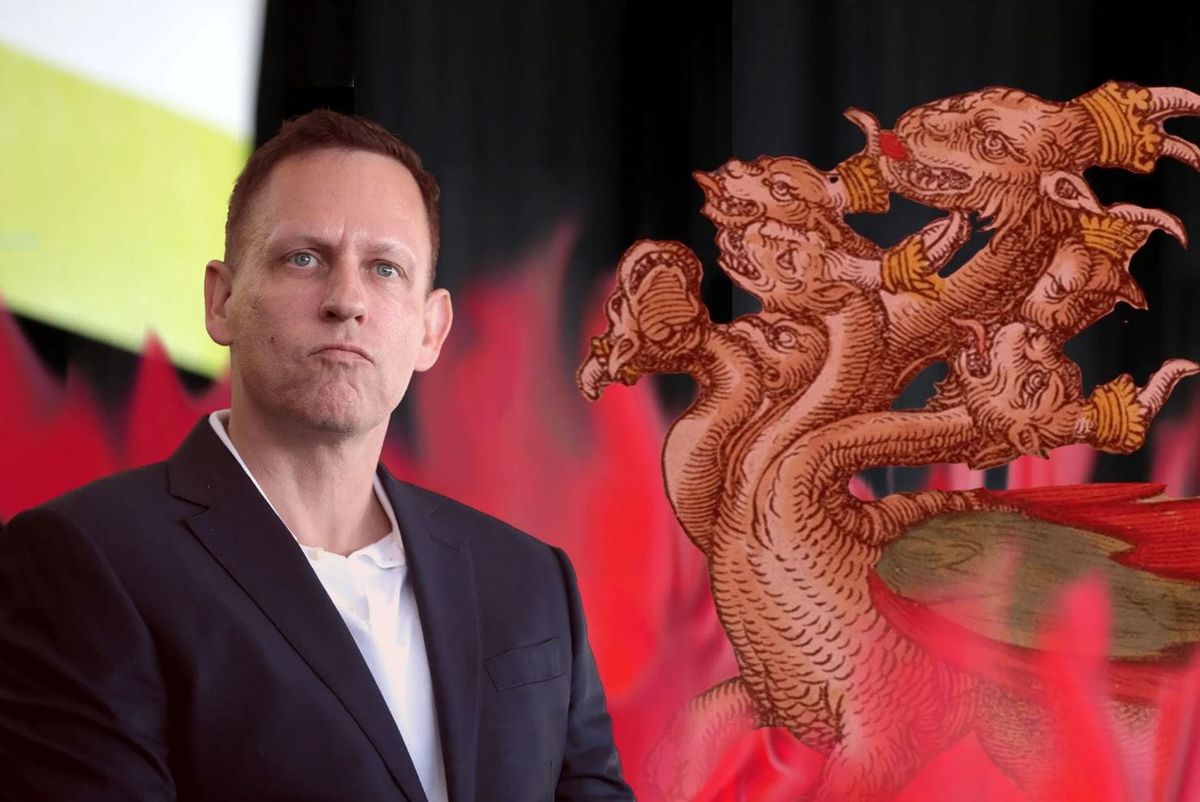
US billionaire Peter Thiel is gathering a handpicked crowd in Rome, literally steps from the Vatican, for a private, four-day deep dive into one of Christianity’s most ominous figures: the Antichrist.
The invitation-only talks started Sunday and wrap up Wednesday. Attendees have been told the venues will move around the city, and phones, laptops, or any recording gear are strictly banned. Thiel, the 58-year-old co-founder of PayPal and Palantir, is using the sessions to lay out his own stark philosophy: that a real-world Antichrist could rise amid today’s cascade of existential threats, and that humanity may be sleepwalking toward Armageddon.
In Christian theology, the Antichrist is the ultimate deceiver—a charismatic, powerful figure who turns people away from Christ and sets the stage for the end times. Thiel has been turning this ancient idea into a modern warning. Last year in San Francisco he gave a similar closed-door series, arguing that an Antichrist-like leader could seize power by exploiting global panic over nuclear war, runaway artificial intelligence, or climate collapse—then promise salvation through a single, all-powerful one world government.
Now he is expanding on those themes in the shadow of St. Peter’s Basilica. The move has already drawn sharp pushback from Catholic thinkers. Father Paolo Benanti, the Vatican’s go-to expert on artificial intelligence and a papal adviser, called Thiel a “political theologian” operating inside Silicon Valley. In an essay published Saturday in Le Grand Continent, Benanti wrote that Thiel’s ideas amount to “a prolonged act of heresy against the liberal consensus” and “challenge the very foundations of civil coexistence.”
Thiel has long been open about his fixation on the Antichrist and the final battle of good versus evil. He frames both as urgent choices facing humanity right now. “Christians debated these prophecies for millennia. Who was the Antichrist? When would he arrive? What would he preach?” he mused in a November essay for the Catholic magazine First Things. Raised in an evangelical Christian household, he has repeatedly said his faith still shapes how he sees the world.
The Rome series appears to mirror the blueprint of his September lectures in San Francisco. Some of the invitations floating around the Italian capital are almost identical to last year’s. One reads: “His remarks will be anchored on science and technology, and will comment on the theology, history, literature and politics of the Antichrist. Religious thinkers upon whom Peter will draw include René Girard, Francis Bacon, Jonathan Swift, Carl Schmitt and John Henry Newman.”
Thiel belongs to the legendary “PayPal Mafia,” the tight-knit group of 1990s and early-2000s entrepreneurs that also produced Elon Musk, Yelp’s Jeremy Stoppelman, and YouTube’s Chad Hurley and Steve Chen. After eBay bought PayPal for $1.5 billion in 2002, Thiel launched the hedge fund Clarium Capital and co-founded Palantir Technologies—whose software recently landed a contract with U.S. Immigration and Customs Enforcement to help identify and deport targeted individuals.
Detailed notes from the San Francisco talks, leaked online by tech worker Kshitij Kulkarni, show Thiel opening with the biblical concept of the Antichrist and linking it directly to today’s doomsday anxieties. Drawing on the Book of Daniel’s prophecy that “knowledge shall be increased” in the last days, he argued that breakneck technological progress is actually heightening apocalyptic fears and paving the way for an authoritarian savior figure.
He pointed out that despite all our gadgets and breakthroughs, people are more obsessed than ever with civilization-ending risks—AI, nuclear weapons, engineered pandemics. These secular terrors, he suggested, echo the old biblical warnings. The Antichrist, in Thiel’s telling, could appear as a leader who offers peace and safety during a global crisis, using that promise to justify one-world rule. The choice, he framed, is between biblical-style catastrophe (Armageddon) or a centralized authority claiming it can stop the disaster.
Thiel also traced how technology itself flipped from pure promise to potential doom. The 1945 atomic bomb, he noted, marked the moment when scientific progress became inseparable from apocalyptic dread. Today’s worries about AI, bioweapons, nuclear war, and even shrinking populations feel like updated versions of end-times prophecy.
In the question-and-answer portion, according to the notes, Thiel went further: the Antichrist would likely be a single, charismatic individual rather than just a system, because modern tools give humanity godlike power to destroy itself. Such a figure, he said, could rise by riding waves of fear and positioning himself as the only one capable of preventing total collapse.